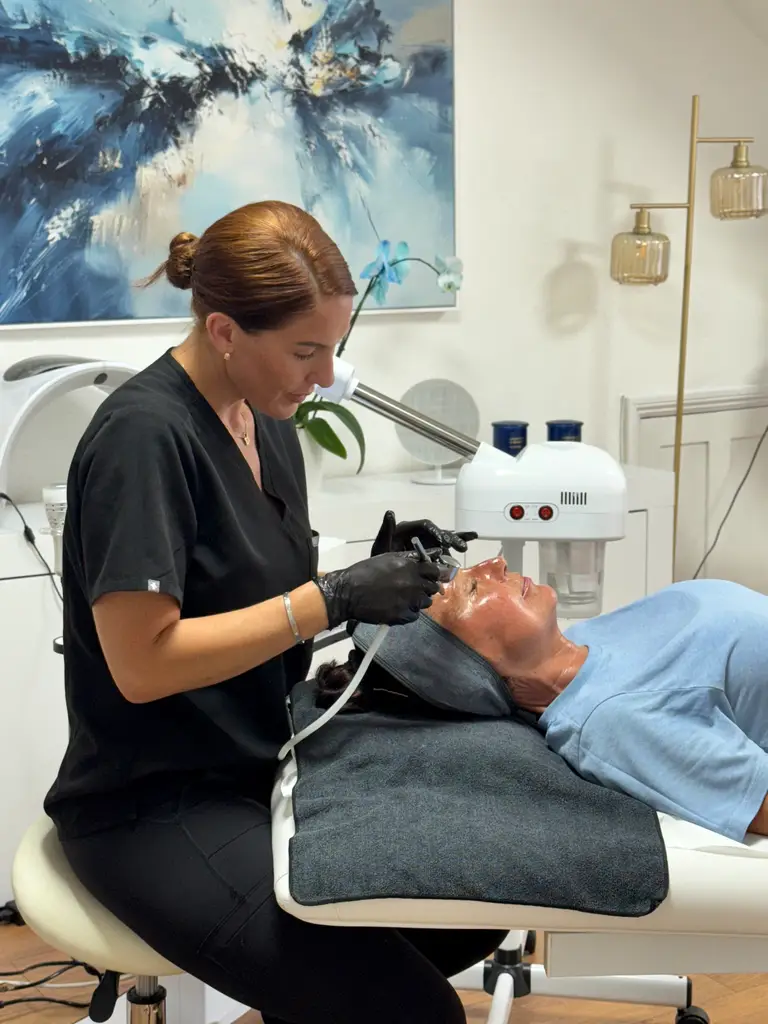
A good consultation should leave you feeling clearer, not more pressured. If you are wondering what happens at a skin consultation, the short answer is that it is a conversation and assessment designed around your skin, your concerns and what feels right for you. It is not about being persuaded into a treatment you did not come in for.
At Rose Skin Aesthetics, the aim is to understand the person behind the concern. You may want help with pigmentation that has gradually become more noticeable, fine lines that make you look tired, unwanted hair, acne scarring, dehydration or a general loss of glow. You may simply feel overwhelmed by skincare advice and want an honest place to start.
What happens at a skin consultation?
Your consultation begins with listening. You will have time to explain what you have noticed about your skin, what you would like to improve and, just as importantly, what you do not want. For many people, that means looking fresher, more rested or more even in tone without looking noticeably ‘done’.
It can help to be specific, but you do not need to know the name of a treatment before you arrive. You might say that make-up sits unevenly around your cheeks, that brown marks linger after the summer, or that your skin feels less firm than it used to. These everyday observations are useful starting points.
Your practitioner will ask about your priorities, timescale and budget. A bride preparing several months ahead will need a different approach from someone hoping to improve dry, dull skin before an event in a few weeks. Equally, a person seeking long-term hair reduction will need a different plan from someone considering injectable skin rejuvenation.
There is no single ‘best’ treatment for everyone. The right recommendation depends on your skin, medical suitability, desired outcome and how much downtime, if any, you are comfortable with.
Your health, skin and treatment history
A thorough consultation includes questions about your health and skincare history. This is an essential part of safe, responsible aesthetics, not paperwork for its own sake. You may be asked about allergies, skin conditions, current medication, previous procedures, pregnancy or breastfeeding, recent illness and any history of cold sores where relevant.
Your practitioner will also want to know what you currently use on your skin. Bring photos or a list if that is easier. Active products such as retinoids, exfoliating acids and certain acne treatments can affect whether a peel, microneedling treatment or laser procedure is appropriate at that time. Recent sun exposure and fake tan matter for laser treatments too.
Be open about previous aesthetic treatments, even if they were carried out elsewhere or some time ago. This helps your practitioner make recommendations with a full picture in mind. Honest answers protect your skin and help avoid treatments being layered together too quickly.
Looking closely at your skin
Next comes the skin assessment. Your practitioner will examine areas of concern and look beyond them at overall skin health. They may assess hydration, texture, sensitivity, pore visibility, pigmentation, redness, fine lines, breakouts, scarring and signs of sun damage.
At Rose Skin Aesthetics, 3D skin analysis may be used to provide a more detailed view of concerns that are not always obvious in a mirror. It can help identify patterns in pigmentation, surface texture and other aspects of skin condition, giving you a helpful baseline for your plan. The analysis is not a diagnosis, but it can make the conversation more precise and allow progress to be reviewed over time.
Lighting, make-up, hormones, stress and the seasons can all influence how skin looks from one day to another. That is why your assessment is considered alongside your own experience of your skin, rather than relying on one image or one measurement alone.
Talking through suitable options
Once your goals and skin assessment are clear, your practitioner can explain the options that may be suitable. This might involve a targeted home skincare routine, a course of advanced facials, chemical peels or microneedling for texture and radiance. For pigmentation or concerns linked to sun damage, laser skin rejuvenation may be discussed. If your main concern is unwanted hair, suitability for SHR laser hair removal will be assessed.
For loss of hydration, fine lines or reduced skin quality, options could include injectable skin boosters, polynucleotides or Profhilo, depending on your needs and suitability. If you are concerned with expression lines or facial balance, anti-wrinkle treatment or carefully placed dermal filler may be considered. The focus should always be on softening or enhancing your natural features, not changing your face.
You should be told what a treatment is designed to address, how it is performed, how many sessions may be needed and when results are likely to become noticeable. Some treatments give a short-term boost, while others work gradually as the skin responds over several weeks or months. A course may offer better value and more meaningful progress for some concerns, but it is not automatically necessary for everyone.
A professional consultation also includes the limitations. Deep acne scarring, longstanding pigmentation, marked laxity and hormonal changes can require a gradual approach and may not be fully resolved by non-surgical treatment. If a concern is outside the scope of aesthetic care, or needs medical assessment, you should be advised appropriately.
Safety, downtime and realistic expectations
Before deciding, you should understand what recovery can look like. A HydroDiamond facial may fit easily into a busy week, whereas a chemical peel, laser treatment or microneedling procedure can bring temporary redness, dryness, flaking or sensitivity. Injectable treatments may involve short-lived swelling, tenderness or bruising. Your practitioner should explain the expected aftercare, warning signs to be aware of and when to contact the clinic.
For some treatments, a patch test is required before proceeding. This is particularly relevant for laser hair removal and certain laser skin treatments. It allows your skin’s response to be checked and helps determine safe settings. A patch test is a sensible safety step, not an inconvenience.
The consultation is also the right time to ask direct questions. Ask what result is realistic for your starting point, whether there are alternatives, how long improvement may last and what maintenance could involve. If something sounds unclear, ask again. You should never feel embarrassed for wanting to understand your treatment.
Building a plan that fits your life
A personalised plan does not have to mean a long list of appointments. Sometimes the most appropriate first step is simplifying your routine and protecting your skin from UV exposure consistently. Sometimes it is a carefully spaced course of treatments, followed by occasional maintenance. In other cases, it may be best to wait until your skin barrier is calmer or a particular medication has been stopped.
Your plan should account for real life. If you have a holiday, wedding, work commitment or family occasion coming up, timing matters. Treatments that create visible redness or peeling need to be planned with enough breathing room. Starting early is usually kinder to your skin than trying to chase a dramatic change immediately before an event.
Cost should be discussed openly too. A good practitioner can help you prioritise the treatments most likely to support your goals and suggest a pace that feels manageable. There is value in doing less, well, rather than trying everything at once.
You do not have to decide on the day
One of the most reassuring parts of a consultation is that it gives you space to think. You may decide to proceed, arrange a patch test or begin with a simple skincare change. You may also decide that now is not the right time. All of these are valid outcomes.
If you go ahead, you should leave knowing what will happen next and how to prepare. If you choose not to, you should still leave with a better understanding of your skin and what it may need.
The best skin plans are built with patience, not pressure. A consultation is simply a chance to be heard, ask questions and make a considered choice that supports healthier-looking skin in a way that still feels like you.